
Biological control means using one living organism to control another, in place of a chemical. It is a well-established idea across agriculture — think of ladybirds eating aphids —and in parasite control it takes a particularly elegant form: a natural fungus that attacks worm larvae in the manure, before they ever reach the pasture.
The organism
The fungus is Duddingtonia flagrans — a nematophagous (literally “worm-eating”) fungus that occurs naturally in pasture soils around the world. It belongs to a group of fungi that have evolved to trap and consume tiny roundworms. The challenge,solved through years of research, was to harness that natural ability in a form that could be fed reliably to grazing animals — work led in Australia by the national science agency, CSIRO, together with International Animal Health.
How it differs from a drench
This is a fundamentally different approach to chemical drenching:
- It acts outside the animal, on the larvae in the dung and pasture — the 90% of the worm population that drenches never reach.
- It works physically, by trapping and eating larvae, not by poisoning them.
- It is effective against drench-resistant larvae, because resistance to a chemical makes no difference to being caught in a net.
- It adds no selection pressure for resistance, and helps preserve refugia.
Why it is a breakthrough
Used this way, biological control is the first commercial means of tackling the part of the worm problem that chemicals can’t — the larvae on the pasture — in a sustainable way. It doesn’t replace drenching; it complements it, and it stays effective in a world where drenches are failing.
The two sections that follow go deeper: The Duddingtonia flagrans Mechanism explains exactly how the fungus traps larvae, and Why Resistance Does Not Develop explains why this approach is expected to keep working.
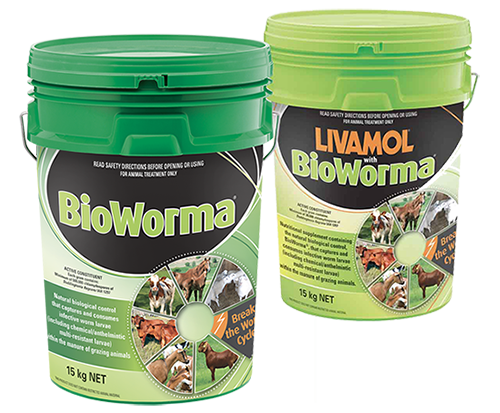
The basis of BioWorma: This science is the foundation of BioWorma, developed by International Animal Health with CSIRO — the world’s first commercial product for the biological control of worm larvae in grazing animals.
The Duddingtonia flagrans Mechanism
The way Duddingtonia flagrans controls worm larvae is both simple and remarkable. Here is the mechanism, step by step.
- Tough resting spores survive the gut. The fungus is fed to grazing animals as thick-walled resting spores (chlamydospores). These are inert inside the animal — having no effect on the host — and pass through the digestive system unharmed.
- They arrive in the dung. The spores end up in the manure, exactly where worm eggs are hatching and larvae are beginning to develop.
- They germinate and grow a net. In the dung pat,the spores germinate and grow fine threads (hyphae), which form sticky three-dimensional networks and loops — microscopic traps spread through the manure.
- They trap the larvae. As worm larvae move through the dung, they are caught in the sticky network and held fast.
- They consume them. The fungus penetrates the trapped larvae and digests them — destroying the larvae inside the dung pat,before they can migrate out onto the surrounding pasture.
Specific, safe and self-limiting
The fungus targets the parasitic larvae developing in the manure. It does not harm the animal, and it has no negative effect on dung beetles, earthworms, soil nematodes or other beneficial soil life — it is residue-free. It is also self-limiting: once it has consumed the larvae in a dung pat, the fungus dies off rather than establishing or spreading, which is why it must be fed daily through the risk period.
How well it works
In trials across multiple species, seasons and climates, this mechanism has reduced the worm larvae reaching pasture by large margins — commonly in the range of two-thirds to nearly all of the larvae, and effective against drench-resistant larvae just as much as susceptible ones. It works whenever larvae are developing in the dung, broadly when temperatures are above about 5°C.
In practice: This mechanism is exactly how BioWorma works. See the BioWorma product section for feeding and usage detail.
Why Resistance Does Not Develop
The single most important advantage of biological control is also the most reassuring: unlike chemical drenches, it is not expected to lose its effectiveness over time. Understanding why comes down to the difference between a poison and a predator.
How chemical resistance works
A drench is a chemical that interferes with a specific biological target inside the worm. Within any worm population, a few individuals carry genetic variations that let them survive that chemical. Each treatment kills the susceptible worms and spares the resistant ones, which then breed the next generation. Over time the resistant type comes to dominate — the drench stops working. This is an almost inevitable consequence of relying on a chemical with a single mode of action.
Why biological control is different
The fungus doesn’t poison the larvae — it physically traps and eats them. That’s a predatory, mechanical action, not a biochemical one, and it offers no single target for a worm to adapt around. There is no known genetic change that would let a larva simply “not be caught” in a sticky net and consumed. So the mechanism that drives chemical resistance — selection on a specific drug target — has nothing to act on here.
No selection pressure on the worms
There is a second, related reason. Because biological control removes larvae out in the dung and pasture rather than dosing the worms inside the animal, and because it kills resistant and susceptible larvae alike, it doesn’t hand any survival advantage to a particular genetic type. It imposes no selection pressure for resistance. It even helps preserve refugia — reducing the worm challenge without skewing the population toward resistance.
Why this matters
Taken together, these points mean biological control is a durable tool. Its effectiveness isn’t expected to erode the way a drench’s does, and — because it works on resistant larvae — it actually becomes more valuable as chemical resistance spreads. It is the sustainable complement that lets the drenches we still have keep working for longer.
A note on wording: No control method can be guaranteed forever, and we describe this carefully: resistance to physical trapping by a nematophagous fungus has no known mechanism and is not expected to develop, which is why biological control is considered a sustainable, long-term tool rather than one with a built-in expiry like chemical drenches.