Introduction
Goats share most of their gut worms with sheep — but they suffer more from them. Having evolved as browsers rather than grazers, goats develop weaker immunity to gastrointestinal worms, so they tend to carry heavier burdens and show disease at lower worm-egg counts than sheep do. That makes vigilant parasite control especially important in goats.
The worms that matter most
- Barber’s pole worm (Haemonchus contortus) — the number-one killer in warm, humid regions. A blood-feeder that causes anaemia and can killquickly, often without scouring.
- Black scour worm (Trichostrongylus) — damages the small intestine, causing dark scouring and steady loss of condition.
- Brown stomach worm (Teladorsagia / Ostertagia) — more of a problem in cooler areas, causing scouring and ill-thrift.
- Thin-necked intestinal worm (Nematodirus) — can hit kids, with sudden scouring; goats’ weaker immunity means adults aren’t fully protected.
- Nodule worm (Oesophagostomum) — forms nodules in the gut wall (“knotty gut”) with green, mucousy scouring.
Beyond the roundworms, coccidia(a single-celled parasite, not a worm) is a major cause of scouring and death in kids, and lungworm and liver fluke matter in some regions. For detailed pages on the individual worms, see the Science & Parasites section.
Who is most at risk
Kids and lactating does are the most vulnerable — does experience a rise in egg output around kidding (the periparturient rise) that seeds pasture just as kids begin grazing. Stress and poor nutrition make everything worse.
Parasite Management for Goats
Two facts shape worm control in goats: they process drenches faster than sheep (so standard sheep doses can under-treat them), and resistance has developed quickly and widely in goat worms. Get the basics right and you protect both your animals and the drenches you rely on.
Monitor first
- Worm-egg counts (WormTest) to gauge the burden and time treatment — remembering goats warrant action at lower counts than sheep.
- FAMACHA eyelid scoring to track anaemia from barber’s pole worm and treat only the animals that need it.
- Larval culture to identify which worms are present, and a drench (egg count reduction) test to find out what still works on your property.
Drench wisely
Use drenches proven effective for you, dose to bodyweight (under veterinary advice, as goats often need higher dose rates than sheep), and avoid under-dosing, which drives resistance. Quarantine-drench all new arrivals so you don’t buy in resistant worms, and preserve refugia by not treating every animal when only some need it.
Graze to your advantage
Rest and rotate pasture so larvae die off, cross-graze with cattle or horses (which are a dead end for goat worms), and keep kids on low-worm-risk pasture. Goats’ natural preference for browsing higher, rather than grazing close to the ground where larvae concentrate, can be used to your benefit. Good nutrition and selecting hardier animals round out the program.
Add biological control
Because resistance is such a problem in goats, reducing the larvae on pasture — so animals pick up fewer worms in the first place — is especially valuable. See Using BioWorma in Goats.
Using BioWorma in Goats
Goats are where biological control can earn its keep most clearly, because resistance leaves goat producers with fewer reliable drenches. In the company’s trials, BioWorma reduced the worm larvae on pasture by an average of around 86% in goats— the highest of the ruminant species tested.
What it does
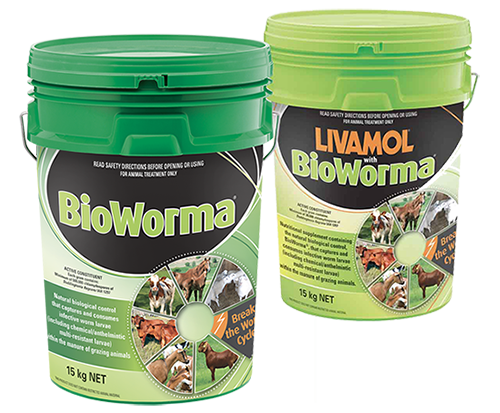
BioWorma contains the natural fungus Duddingtonia flagrans. Fed daily, the tough spores pass through the goat unharmed and end up in the dung, where they grow a microscopic net that traps and consumes worm larvae in the manure, before they reach the pasture — including drench-resistant larvae. It works on the gut roundworms whose larvae develop in the dung: barber’s pole, black scour, brown stomach and nodule worms, and hookworm.
How it’s fed
BioWorma is fed every day, scaled to bodyweight — either as the concentrated additive mixed through feed, or as Livamol with BioWorma, a ready-to-use protein supplement that can be top-dressed. Because the fungus doesn’t establish or persist, it needs to be fed continuously through the risk period; it is best used strategically when conditions favour larval development (broadly, temperatures above about 5°C).
How it fits
BioWorma reduces reinfection from pasture; it does not kill the worms already inside an animal, so you still treat clinical cases and existing burdens with an effective drench. It also won’t affect parasites that aren’t picked up from larvae in the dung, such as coccidia or lungworm. Used alongside monitoring, strategic drenching and grazing, it lowers the worm challenge while leaving refugia intact — and it’s residue-free, safe to feed to pregnant does, and harmless to dung beetles, earthworms and soil life.
Animals Overview