Drench classes
Anthelmintics are grouped by chemical family. The main broad-spectrum classes used in Australian sheep and goats are:
- Benzimidazoles (BZ) — “white” drenches, such as albendazole, oxfendazole and fenbendazole.
- Levamisole (LEV) — “clear” drenches.
- Macrocyclic lactones (ML) — “mectins”, including ivermectin, abamectin and moxidectin.
- Amino-acetonitrile derivatives (AAD) — “orange” drench (monepantel).
- Spiroindoles (derquantel), usually sold combined with abamectin.
There are also narrow-spectrum products particularly useful against barber’s pole worm, such as closantel and naphthalophos. Many products are combinations of two or more classes, which generally kill a higher proportion of worms and slow resistance — provided the components are still effective. The practical rule is simple: use only what is proven to work on your property, and follow the label dose.
Ivermectin
Ivermectin was the first of the macrocyclic lactones registered for sheep in Australia, arriving in the late 1980s. The mectins paralyse worms by acting on specific (glutamate-gated chloride) channels in the worm’s nerve and muscle cells. Within the group, moxidectin is generally the most potent, followed by abamectin, then ivermectin.
When the mectins arrived they transformed worm control. But barber’s pole worm developed resistance to ivermectin within just a few years, and that resistance is now widespread. Ivermectin may still work in some situations, but it can no longer be assumed effective — a resistance test is the only way to be sure.
Resistance
Drench resistance means a drench no longer kills enough of the worms to be useful — conventionally defined as less than a 95% reduction in egg count compared with untreated animals. It develops because every drench leaves behind the few worms that happen to survive it; if those resistant survivors go on to breed most of the next generation, the population shifts toward resistance. Frequent drenching, under-dosing and relying on a single group all speed this up.
In Australia the picture is sobering: resistance to the white (BZ) drenches affects around 90% of sheep farms and to the clear (LEV) drenches around 80%, while mectin resistance in barber’s pole worm is common in the summer-rainfall northern region. Crucially, resistance can’t be reversed — once a property loses a drench group, it generally stays lost. That is why protecting the drenches we still have is a priority.
Refugia
“Refugia” means the portion of the worm population that is not exposed to a drench at the time of treatment — the worms in animals you didn’t treat, plus all the eggs and larvae already on the pasture. These unexposed worms stay susceptible, and when they breed with any survivors they dilute the resistant genes, slowing resistance down.
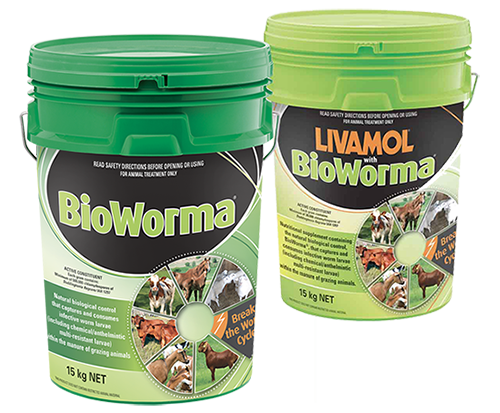
In practice that means: don’t drench every animal if some don’t need it, avoid drenching and immediately moving stock onto a completely clean paddock (which removes the susceptible refugia), and don’t treat more often than necessary. Biological control fits neatly here — it lowers pasture larvae without putting any chemical selection pressure on the worms, so it reduces infectivity while leaving refugia intact.
Monitoring
Good decisions start with knowing your worm burden rather than guessing. The core tools are:
- Faecal egg counts (a “WormTest”) — counting worm eggs per gram of dung to gauge the burden in a mob and decide if and when to drench.
- Larval culture — growing the eggs on to identify which worm species are present (important, because barber’s pole worm needs different handling to scour worms).
- Faecal egg count reduction test (a “DrenchTest”) — comparing egg counts before and after treatment to find out which drenches still work on your property.
Monitoring lets you treat on need, not on the calendar — saving drenches, money and the worms’ susceptibility.
FAMACHA
FAMACHA is a simple, field-friendly check made specifically for barber’s pole worm. Because the worm causes anaemia, the colour of the lower inner eyelid reflects how much blood an animal has lost. You compare the eyelid against a laminated chart scored 1 (healthy red) to 5 (white, severely anaemic), and treat only the animals that need it — typically those scoring 3 or worse.
This “targeted selective treatment” has two big benefits: it leaves the more resistant, better-coping animals untreated (preserving refugia and identifying which animals to keep), and it focuses your effort where it counts — often a minority of the mob carries most of the burden. A few points to remember: FAMACHA works only for blood-feeding worms like barber’s pole, not for scour worms; it is best used alongside faecal egg counts; and it pays to be trained so your scoring stays consistent.