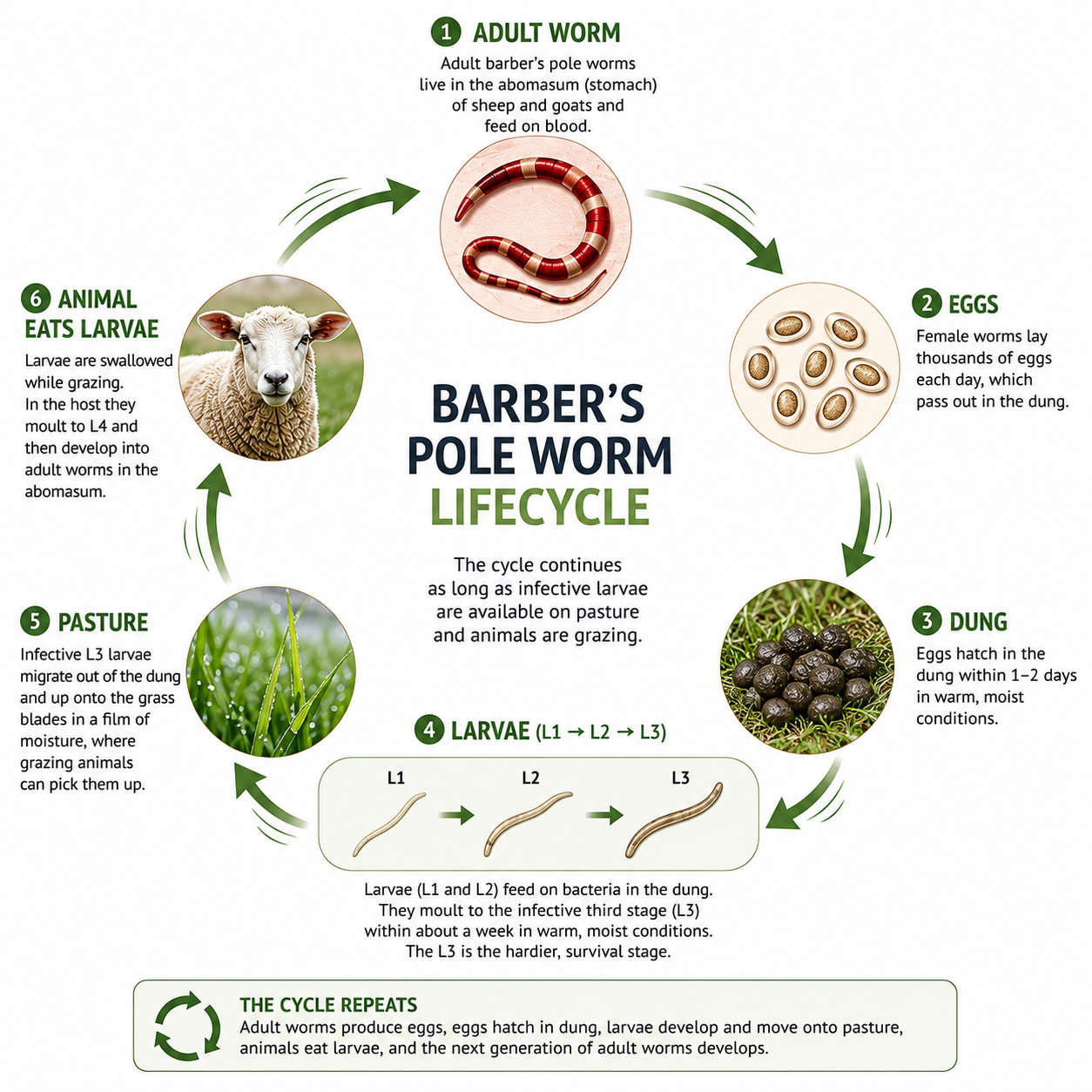
Key Lifecycle Facts Barber's Pole Worm
· Females can lay 5,000–10,000 eggs per day.
· Eggs hatch in warm, moist conditions.
· Infective larvae develop within about a week.
· Most of the worm population exists on pasture.
· Larvae survive longest in cool, moist conditions.
· Lifecycle can be completed in as little as three weeks.
Understanding the free-living stages — the part of the lifecycle that happens outside the animal — is the key to lowering pasture infectivity. This is where grazing management and biological control do their work.
Eggs
The barber’s pole worm is one of the most prolific egg-layers of all sheep worms. A single female can shed in the order of 5,000 to 10,000 eggs a day — far more than most other gut worms, which lay only hundreds. Those eggs pass out in the dung onto the pasture. Because output is so high, a relatively small number of adult worms can seed a paddock with enormous numbers of eggs in a short time. Eggs hatch within a day or two when conditions are warm and moist.
Larvae
Newly hatched larvae (the L1 and L2 stages) live in the dung pat and feed on bacteria. These early stages are fragile — they are easily killed by drying and cold. Within about a week in warm, moist conditions (around 20–25°C is ideal) they moult into the infective third stage (L3).
The L3 is the survivor. It is sealed inside a retained outer sheath, doesn’t feed, and is far hardier than the earlier stages. In a film of moisture it migrates out of the dung and a few centimetres up the grass blades, where a grazing animal eats it. Once swallowed, host signals — warmth, carbon dioxide and stomach conditions —trigger it to develop into the L4 and then the adult worm in the abomasum.
Pasture contamination
Everydung pat dropped by an infected animal becomes a launch pad for thousands of larvae. Because larvae gather low on the sward — in the bottom few centimetres of grass — contamination concentrates exactly where hungry animals graze closest to the ground. Under continuous grazing, larvae accumulate faster than they die off, and infectivity climbs.
Two seasonal surges make this worse. Larvae that paused inside the animal over winter or a dry spell resume development and are shed in a spring rise; and around lambing, a temporary drop in the ewe’s immunity drives a periparturient egg rise. Both flood the pasture with eggs just as the most vulnerable animals — newborn and young stock — begin grazing.
This is also why the roughly 90% of the population that sits on pasture matters so much: it is the reservoir that re-infects your stock between drenches.
Why Most Worm Control Programs Struggle
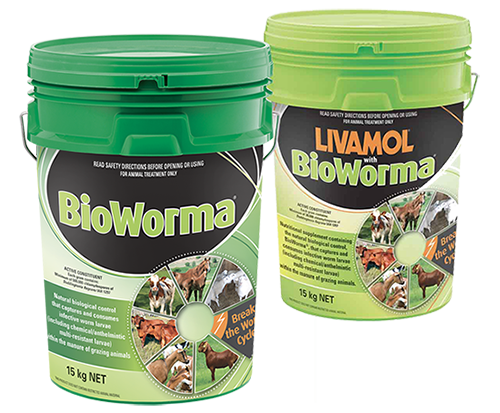
Most worm control programs struggle to maintain their effectiveness due to the majority of the worm population existing on pasture rather than inside the animal. Grazing animals can become reinfected soon after treatment while pasture contamination remains high - it is imperative to break the cycle.
Seasonal factors
Temperature and moisture govern almost everything. Warm, moist weather lets eggs and larvae develop fast and inl arge numbers, so burdens can build explosively after summer or autumn rain in warm regions. Hot, dry spells and cold both slow or stop development. In many areas the heaviest larval availability comes when warmth and moisture coincide— often late spring and autumn.
The worm also adapts. Through hypobiosis (paused larval development inside the host) it rides out hostile seasons and re-emerges when conditions improve. In cooler, winter-rainfall parts of Australia it has shifted its timing so that it can develop at lower temperatures — which is why barber’s pole worm is increasingly seen outside the classic summer-rainfall zone.
Environmental survival
The infective L3 is built to last. Depending on the weather, it can survive on pasture from a few weeks to several months — longest in mild, moist conditions, shortest in heat and drought. As a guide, pastures often become much less infective by around 90days, although larvae can persist longer when it stays cool and damp.
Microclimate matters: larvae survive better in tall, dense pasture that holds moisture and shades the soil than on short, exposed swards that dry out.Moisture, more than anything, is the limiting factor — larvae need it to develop and to climb the grass. This is the science behind pasture spelling: give the larvae long enough with no new host, and most of them die before your animals return. See Prevention & Pasture Management for how to put this to work.